
Select your language

Social Dude
QuickBooks Database Server Manager Setup Made Simple

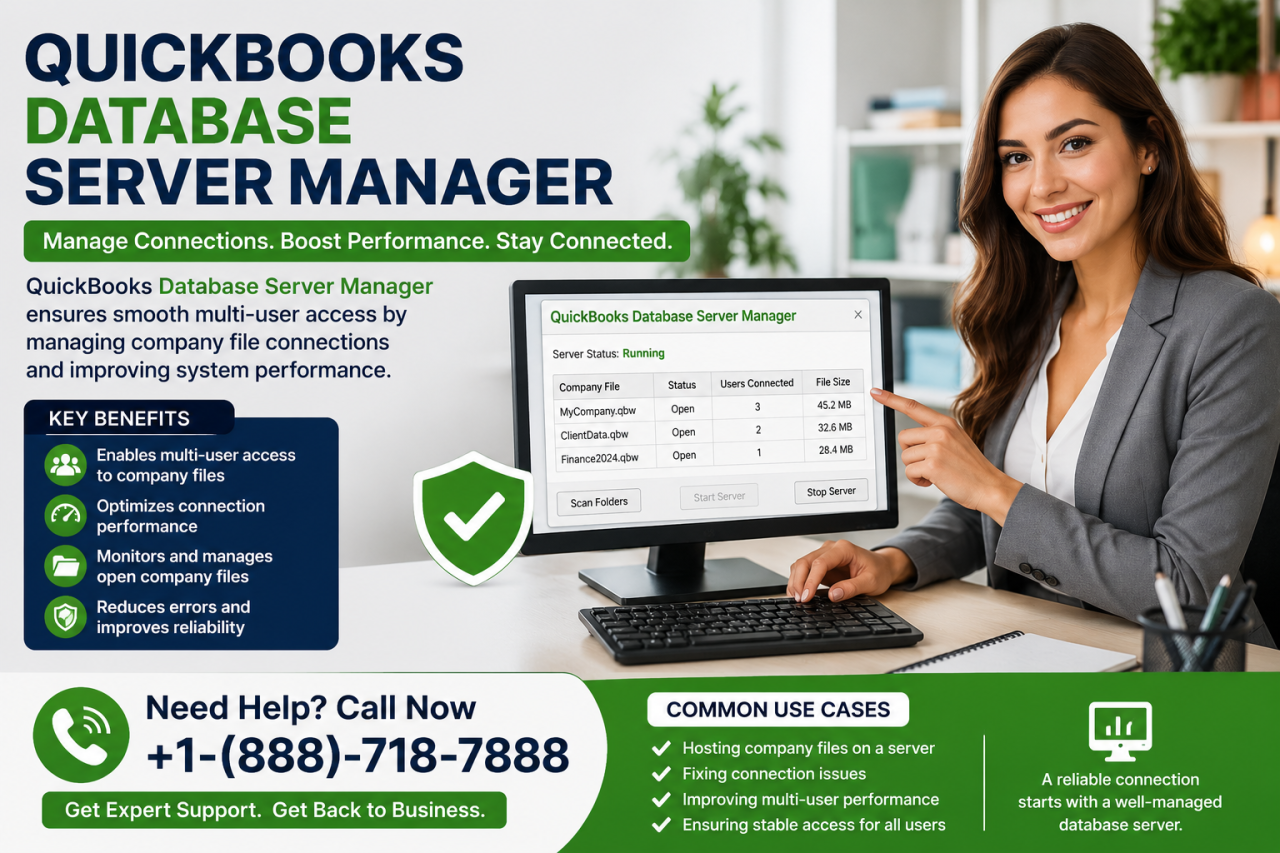
Introduction: The Backbone of Multi-User QuickBooks
You have three employees who need to access QuickBooks at the same time. One is entering invoices. Another is running payroll. A third is reconciling bank statements. Everyone needs to work simultaneously without stepping on each other's toes. How does QuickBooks make this possible?
The answer is the QuickBooks Database Server Manager. This essential utility is the hidden engine that allows multiple users to access the same company file over a network without data corruption or performance issues . Think of it as a traffic controller for your QuickBooks data—it manages who gets access, when, and ensures everyone sees the latest information in real-time .
Without the Database Server Manager, multi-user mode simply will not work. If you are setting up a network for the first time or troubleshooting connection errors like H202, H303, or H505, this guide will walk you through everything you need to know .
If you get stuck during setup and need immediate help, call +1-(888)-718-7888. In this complete guide, we will cover what the QuickBooks Database Server Manager is, how to install and configure it, how to troubleshoot common issues, and best practices for keeping your multi-user network running smoothly.
What Is QuickBooks Database Server Manager?
The QuickBooks Database Server Manager is a utility that allows you to share your QuickBooks company files over a network, enabling multiple users to access the same files simultaneously . It is like the heartbeat of your QuickBooks network—essential for running QuickBooks in multi-user mode smoothly.
Key Functions of the Database Server Manager
Function | Description |
Hosts company files | Stores and manages access to your .QBW files on a central server computer |
Manages user connections | Coordinates simultaneous access from multiple workstations |
Scans company files | Regularly monitors your files to ensure they are up-to-date and running without issues |
Prevents data corruption | Organizes who gets served first and how data gets shared seamlessly |
Monitors network health | Helps you track the status of your multi-user environment |
Do You Need It?
If you plan to have multiple users accessing the same QuickBooks company file at the same time, you need the QuickBooks Database Server Manager installed on your server computer . If you are a single user working alone on one computer, you do not need this tool .
The Database Server Manager is not a standalone download—it is part of the QuickBooks Desktop installation file. You install it by running the QuickBooks installer and selecting the appropriate network options .
Note:- Experiencing QuickBooks Migration Failed Unexpectedly error? Learn effective solutions to transfer data successfully and avoid migration interruptions.
How QuickBooks Database Server Manager Works
To understand the Database Server Manager, you need to know how QuickBooks finds your company file on the network.
The Role of the .ND File
QuickBooks Desktop uses a small text file called the .ND file (Network Descriptor) to locate the server hosting your company file . This file has the same name as your company file (.QBW) but with a .nd extension, and it is located in the same directory as your company file.
The .ND file contains the information needed to contact the server, such as the IP address and port . Here is how the process works:
- When a workstation tries to open a company file, QuickBooks looks for the .nd file
- If found, QuickBooks determines whether the company file is already in use
- QuickBooks tries to communicate with the server using the information in the .nd file
- If successful, the company file opens in multi-user mode
- If unsuccessful, you see network errors like H202 or H505
The Database Server Manager ensures that the server is properly configured to respond to these connection requests from workstations.
System Requirements for Database Server Manager
Before installing, ensure your server computer meets these requirements:
Requirement | Specification |
Operating System | Windows Server 2025, Windows Server 2022, Windows 11 (64-bit), Windows 10 (64-bit) |
Network | Stable wired Ethernet connection (Wi-Fi not recommended for servers) |
Administrator Access | Required for installation and configuration |
Firewall | Must allow QuickBooks ports (8019, 56728, 55378-55382) |
QuickBooks Version | Same version as workstations (or newer for backward compatibility) |
Important: The QuickBooks Database Server Manager does not support devices like Network Attached Storage (NAS) . You must install it on a dedicated Windows computer that acts as your server.
How to Install QuickBooks Database Server Manager
Installing the Database Server Manager is straightforward but requires careful attention. Follow these steps exactly.
Step 1: Choose Your Server Computer
Select the computer that will host your company files. This should be a computer that is always on when QuickBooks needs to be accessed . A dedicated server is ideal, but a powerful workstation that stays on can work for smaller setups.
Best Practice: Intuit strongly recommends using a computer that will remain on the network and not be used for other intensive tasks .
Step 2: Download QuickBooks Desktop Installer
- Go to the official Intuit Downloads & Updates page
- Select your product (Pro, Premier, or Enterprise) and version
- Download the installer file (Setup_QuickBooks.exe)
Note: The Database Server Manager is not a separate download. It is included in the QuickBooks Desktop installer .
Step 3: Run the Installer as Administrator
- Close all open programs on your server computer, including any instances of QuickBooks
- Right-click the installer file and select Run as administrator
- Follow the on-screen instructions until you reach the installation type screen
Step 4: Select Custom or Network Installation (Critical Step)
This is the most important step. Do not select Express install .
- Select Custom or Network options, then select Next
Step 5: Choose Your Installation Option
You will see two options :
Option | Description | When to Use |
I'll be using QuickBooks Desktop on this computer, AND I'll be storing our company file here | Installs both the full QuickBooks program and Database Server Manager | You want to use the server computer as a workstation as well |
I will NOT be using QuickBooks Desktop on this computer | Installs only the Database Server Manager | You want a dedicated server (recommended for larger networks) |
Intuit strongly recommends the first option if you plan to use the server computer as a workstation .
Step 6: Complete Installation
- Select Next
- Select Install
- When prompted, allow the installation to proceed
Step 7: Note the Windows User Account
After installation, QuickBooks creates a new Windows user account for the Database Server Manager . The account name follows this pattern:
- QuickBooks 2025: QBDataServiceUser34
- QuickBooks 2024: QBDataServiceUser33
- QuickBooks 2023: QBDataServiceUser32
- QuickBooks 2022: QBDataServiceUser31
- QuickBooks 2021: QBDataServiceUser30
Note: You must give this user account permission to access the folders that hold your company files.
How to Configure QuickBooks Database Server Manager
After installation, you need to configure the Database Server Manager for optimal performance.
Step 1: Set the Service to Run Automatically
The Database Server Manager runs as a Windows service called QuickBooksDBXX (where XX is the version number) .
Instructions:
- Press Windows + R, type services.msc, and press Enter
- Scroll to find QuickBooksDBXX (for example, QuickBooksDB33 for 2024)
- Double-click the service to open its properties
- On the General tab, set Startup type to Automatic
- If the service is not running, select Start
- Select Apply and then OK
Step 2: Configure Recovery Options
To ensure the service restarts automatically if it fails:
- In the service properties, go to the Recovery tab
- From the First failure dropdown, select Restart the Service
- Do the same for Second failure and Subsequent failures
- Select OK to save changes
This ensures that if the Database Server Manager crashes, it will restart without you needing to intervene.
Step 3: Verify the Service Account
- In the service properties, go to the Log On tab
- Ensure Local System account is selected
- Select OK
Step 4: Grant Folder Permissions to QB Data Service User
The Database Server Manager needs access to the folders containing your company files .
Instructions:
- Open File Explorer and navigate to the folder containing your company files
- Right-click the folder and select Properties
- Go to the Security tab
- Select Edit to change permissions
- Select Add
- Type QBDataServiceUserXX (replace XX with your version number, e.g., QBDataServiceUser33)
- Select Check Names to verify the account exists
- Select OK
- Grant Full control to the QBDataServiceUser account
- Select Apply and then OK
If you skip this step, the Database Server Manager will not be able to access your company files.
How to Run and Use QuickBooks Database Server Manager
Once installed and configured, you need to scan your company file folders so the Database Server Manager can monitor them .
Using the QuickBooks Tool Hub (Recommended Method)
The QuickBooks Tool Hub provides the easiest way to access the Database Server Manager .
Step 1: Download and Install QuickBooks Tool Hub 1.6.0.8
- Close QuickBooks completely
- Download the most recent version (1.6.0.8) of the QuickBooks Tool Hub from Intuit's website
- Open the downloaded file (QuickBooksToolHub.exe) and follow the installation prompts
- Double-click the icon on your Windows desktop to open the Tool Hub
Step 2: Run the Database Server Manager
- From the QuickBooks Tool Hub, select Network Issues
- Select QuickBooks Database Server Manager
- If QuickBooks is not on your server, it will prompt you to install it
Step 3: Scan Your Company File Folders
- Inside the QuickBooks Database Server Manager, you will see your company file folder(s) if they were previously scanned
- If you see your folder, select Start Scan
- If you do not see your folder, select Browse to locate your company file folder
- Once you have selected the correct folder, select Start Scan
The Database Server Manager will:
- Scan the folder for company files
- Automatically repair your firewall permissions
- Add the folder to its monitoring list
Step 4: Complete the Scan
When the scan finishes, select Close .
You can now open QuickBooks on your workstations and switch to multi-user mode.
Using the Standalone Database Server Manager
If you prefer not to use the Tool Hub, you can also access the Database Server Manager directly:
- Open the Windows Start menu
- Search for QuickBooks Database Server Manager
- Select the application to open it
- Follow the same scanning steps as above
Updating QuickBooks Database Server Manager
Keeping the Database Server Manager updated is crucial for compatibility and security . The tool updates automatically when you update QuickBooks Desktop on your server computer.
How to Check for Updates
- Open QuickBooks Desktop on your server computer
- Go to Help → Update QuickBooks Desktop
- Click the Update Now tab
- Check Reset Update
- Click Get Updates
- After downloads complete, restart QuickBooks and install the updates
The Database Server Manager will update automatically with the QuickBooks updates. Regular updates ensure your QBDSM interacts with your company files like a well-oiled machine, smoothly integrating changes and safeguarding against potential security vulnerabilities .
If You Have Multiple QuickBooks Versions
If you host multiple versions of QuickBooks Desktop on your network, install the oldest version first and end with the most recent version . Each version will have its own Database Server Manager service (QuickBooksDB29 for 2019, QuickBooksDB30 for 2020, etc.) .
Troubleshooting Common Database Server Manager Issues
Even with proper setup, issues can arise. Here are the most common problems and their solutions.
Issue 1: Database Server Manager GUI Will Not Open
Symptoms: The Database Server Manager icon appears briefly in the system tray but disappears when you try to open it .
Solutions:
- Restart the QuickBooks Database Service Manager :
- Press Windows + R, type services.msc, press Enter
- Find QuickBooksDBXX for your version
- Right-click and select Restart
- Ensure the QBDataServiceUser account has administrator privileges :
- Open Control Panel → User Accounts
- Find QBDataServiceUserXX for your version
- Select Change the account type → Administrator
- Run the Tool Hub as administrator
- If the issue persists, contact QuickBooks Desktop support
Issue 2: Error H202 or H505
These errors indicate that workstations cannot communicate with the server .
Solutions:
- Run the QuickBooks Database Server Manager from Tool Hub:
- Open Tool Hub → Network Issues → QuickBooks Database Server Manager
- Scan your company file folders
- The tool will automatically repair firewall permissions
- Check hosting settings:
- Your server should be the only computer with hosting enabled
- Workstations should have hosting turned off
- Run QuickBooks File Doctor:
- From Tool Hub, select Company File Issues → Run QuickBooks File Doctor
- Select your company file and choose Check your network
- Enter your admin password
- Check firewall settings:
- Ensure ports 8019, 56728, and 55378-55382 are open
Add exceptions for QBW32.exe and QBDBMgrN.exe
Issue 3: Database Server Manager Not Detecting Company Files
Symptoms: The Database Server Manager scans your folder but does not find any company files.
Solutions:
- Verify the folder path is correct
- Check permissions for QBDataServiceUserXX on the folder
- Verify the company file is not corrupted by running QuickBooks File Doctor
- Check network connectivity between the server and workstations
Issue 4: Slow Performance in Multi-User Mode
Solutions:
- Use wired Ethernet connections instead of Wi-Fi for all computers
- Ensure your server has enough RAM (8 GB or more recommended)
- Keep your company file size under 500 MB (Pro/Premier) or 1 GB (Enterprise)
- Run regular file maintenance using Verify and Rebuild Data utilities
Hosting Settings: Server vs. Workstations
Incorrect hosting settings are a leading cause of multi-user connection errors . Here is how to verify your settings:
On Your Server Computer (The File Host)
- Open QuickBooks on your server
- Go to File → Utilities
- If Host Multi-User Access is an option, select it
- If Stop Hosting Multi-User Access is an option, do not select it—you are already hosting
On Each Workstation
- Open QuickBooks on the workstation (do not open a company file)
- Go to File → Utilities
- If you see Stop Hosting Multi-User Access, select it to turn hosting OFF
- If you see Host Multi-User Access, do not select it—hosting is already OFF
Repeat these steps for every workstation on your network. Only the server should have hosting enabled .
Firewall Configuration for Database Server Manager
Firewalls often block the Database Server Manager from communicating with workstations . Here is how to configure your firewall correctly.
Ports to Open
QuickBooks uses specific ports depending on your version:
QuickBooks Version | Ports |
2024 and Later | 8019, 56728, 55378-55382 |
2023 | 8019, 56727, 55373-55377 |
2022 | 8019, 56726, 55368-55372 |
Programs to Allow
Add exceptions for these executables:
Program | Location |
QBW32.exe | C:\Program Files\Intuit\QuickBooks (year)\ |
QBDBMgrN.exe | C:\Program Files\Intuit\QuickBooks (year)\ |
How to Add Firewall Exceptions (Windows)
- Press Windows + R, type firewall.cpl, press Enter
- Click Advanced settings
- Right-click Inbound Rules → New Rule
- Select Port → Next
- Select TCP and enter the ports for your version
- Select Allow the connection
- Check all three profiles (Domain, Private, Public)
- Name the rule and click Finish
- Repeat for Outbound Rules
Also add program exceptions for QBW32.exe and QBDBMgrN.exe using the Program rule type .
Best Practices for Database Server Manager
Follow these best practices to keep your multi-user network running smoothly:
1. Use a Dedicated Server (When Possible)While you can use a workstation as a server, a dedicated server computer provides better performance and reliability for larger teams .
2. Keep Your Server On and AwakeConfigure your server computer to never sleep:
- Go to Power Options → Never sleep
- Disable hibernation
- Run the Database Server Manager scan weekly
- Run QuickBooks File Doctor monthly
- Update QuickBooks and Windows regularly
- Store backups on a different drive or cloud storage
- Test your backups regularly
If you notice performance degradation, check how many users are connected. QuickBooks Desktop has user limits:
- Pro and Premier: 5 users maximum
- Enterprise: Up to 40 users
Keep a record of:
- Server computer name and IP address
- QBDataServiceUser account name for your version
- Folder paths for company files
- Firewall exception rules
Frequently Asked Questions (FAQs)
Q1: Do I need QuickBooks Database Server Manager for single-user mode?
A: No. The Database Server Manager is only required for multi-user access where multiple people need to access the same company file simultaneously . Single users working alone do not need this tool.
Q2: Can I install Database Server Manager on a NAS device?A: No. The QuickBooks Database Server Manager does not support devices like Network Attached Storage (NAS) . You must install it on a Windows computer.
Q3: How do I know if Database Server Manager is running?A: You can check by opening the Services console (services.msc) and looking for QuickBooksDBXX where XX is your version number. The status should be "Running" .
Q4: Why do I have multiple QBDataServiceUser accounts on my server?A: QuickBooks creates a separate QBDataServiceUser account for each version of QuickBooks installed on the server . For example, QBDataServiceUser30 for 2020, QBDataServiceUser33 for 2024.
Q5: Can I install Database Server Manager on multiple computers?A: No. The Database Server Manager should be installed only on the computer designated as the server for hosting your company files . Other computers access these files via the network.
Q6: What is the difference between Database Server Manager and QuickBooks Desktop?A: QuickBooks Desktop is the full accounting program. The Database Server Manager is a utility that runs in the background on your server to manage multi-user access to company files .
Q7: How often should I update Database Server Manager?A: Regular updates are crucial. Check for updates whenever there are new QuickBooks updates to ensure compatibility and smooth functioning .
Q8: Why am I getting Error H202 after installing Database Server Manager?A: Error H202 typically means the Database Server Manager is not running, your firewall is blocking the connection, or hosting settings are incorrect . Run the Database Server Manager scan from the QuickBooks Tool Hub to automatically repair firewall permissions .
Q9: Can I use QuickBooks in multi-user mode without Database Server Manager?A: No. The Database Server Manager is essential for multi-user access in a networked environment . Without it, workstations cannot communicate with the server computer hosting the company file.
Q10: What should I do if the Database Server Manager keeps disconnecting?A: Verify your network settings and firewall permissions. Frequent disconnections might also be resolved by updating the server manager to the latest version and ensuring the server computer never sleeps .
When to Call for Technical Help
You have followed every step. You installed the Database Server Manager correctly. You scanned your folders. You configured your firewall. You checked your hosting settings. But workstations still cannot connect to the company file, and errors like H202 or H505 persist.
At this point, the issue is likely one of three things:
- Deep network configuration issues that require advanced IT support
- A corrupted Database Server Manager installation that needs professional repair
- A known bug in your specific version that requires an engineering fix from Intuit
For direct assistance with QuickBooks Database Server Manager and multi-user setup, call: 1-888-718-7888.
When you call, have this information ready:
- Your QuickBooks version and year (e.g., QuickBooks Desktop Enterprise 2024)
- Your Windows Server or Windows version
- The exact error code (H202, H505, or others)
- Whether you have installed the Database Server Manager and scanned your folders
- A list of solutions you have already tried from this guide
Tell the representative: "I have already installed the QuickBooks Database Server Manager, scanned my folders, configured my firewall, and checked my hosting settings. I need help with [insert error code]."
Final Thoughts: The Key to Multi-User Success
The QuickBooks Database Server Manager is the unsung hero of multi-user QuickBooks environments. It works behind the scenes, allowing your team to access the same financial data simultaneously without conflict or corruption.
Installing and configuring it correctly is essential for a smooth multi-user experience. Start by choosing the right server computer. Install using the Custom or Network option. Do not forget to grant permissions to the QBDataServiceUser account.
Run the Database Server Manager from the QuickBooks Tool Hub and scan your company file folders. Configure your firewall to allow QuickBooks traffic. And remember: only your server should have hosting enabled.
When things go wrong—because sometimes they do—work through the troubleshooting steps in this guide. Restart the service. Check your firewall. Verify your hosting settings. Run the QuickBooks File Doctor.
Your team depends on QuickBooks to run your business. Keep the Database Server Manager running, and keep your business moving.
About the author
Categories










Comments