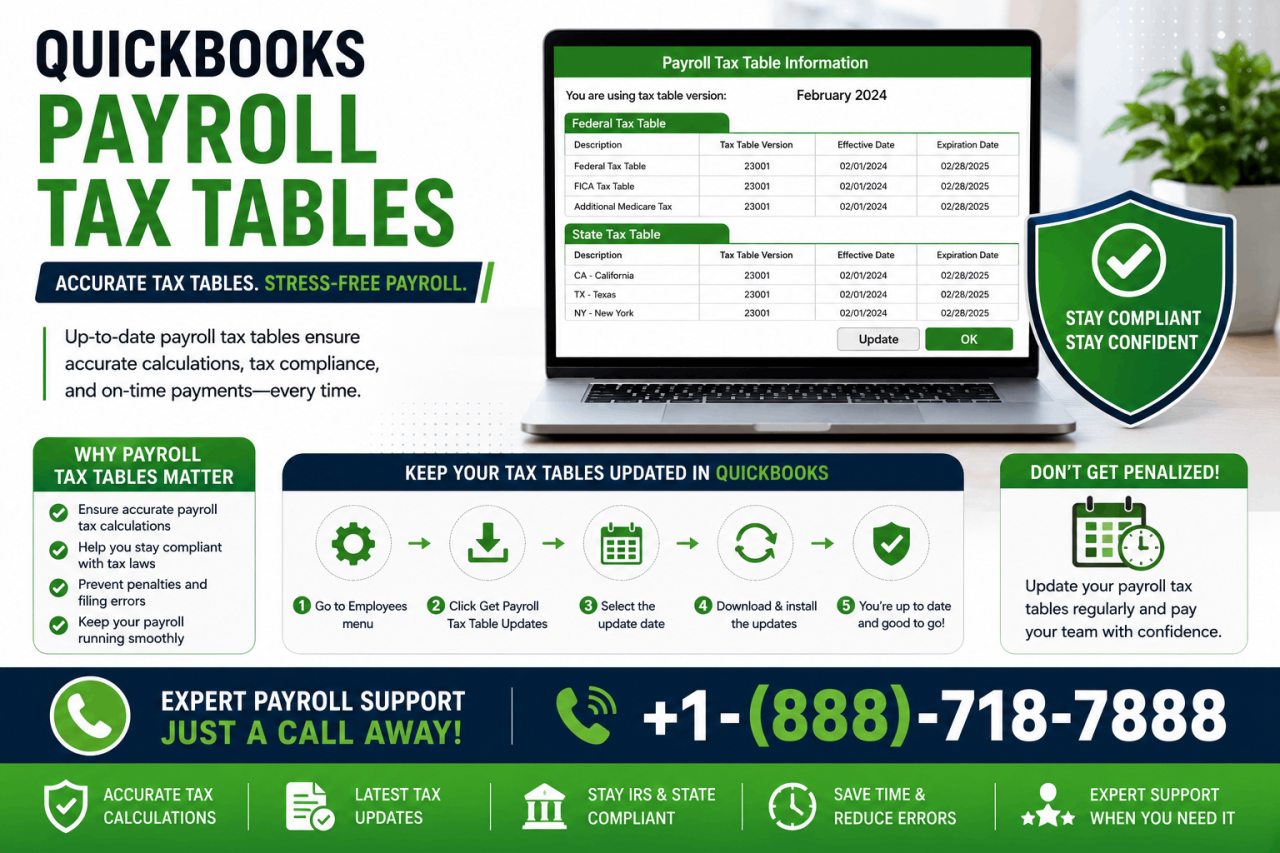
It is payday. You have calculated hours, approved time off, and double-checked every entry. You click "Create Paychecks," and then—instead of processing payroll—a warning appears: "Your payroll tax tables are out of date. Please update before processing payroll." Your heart sinks. Employees are waiting. Bills are due. And you cannot run payroll until QuickBooks gets its tax tables updated.
The QuickBooks payroll tax table update is essential for accurate payroll processing. These tables contain the federal, state, and local tax rates, withholding formulas, and unemployment insurance calculations that determine how much to deduct from each employee's paycheck. When these tables are outdated, your payroll calculations are wrong—sometimes dangerously wrong. If you are stuck with outdated tax tables and need immediate help, call +1-(888)-718-7888.
In this complete guide, we will cover what payroll tax tables are, why they matter, how to update them, and exactly what to do when updates fail. If you are currently unable to update your payroll tax tables, call +1-(888)-718-7888 for immediate assistance.
What Are QuickBooks Payroll Tax Tables?
QuickBooks payroll tax tables are the built-in calculation engines within QuickBooks Desktop that determine how much tax to withhold from each employee's paycheck. They are essentially digital rulebooks that tell QuickBooks exactly how much money to take out for federal income tax, Social Security, Medicare, and state and local taxes.
Think of them as a constantly updating GPS for your payroll. Just as a GPS needs the latest road maps to give you accurate directions, QuickBooks needs the latest tax tables to calculate accurate withholdings. When the tables are outdated, your payroll calculations are incorrect, and you risk fines, penalties, and unhappy employees.
What's Included in the Tax Tables
| Tax Type | Description |
|---|---|
| Federal Income Tax | Based on IRS Form W-4 and current federal withholding brackets |
| Social Security (FICA) | 6.2% up to the annual wage base limit |
| Medicare (FICA) | 1.45% with no wage base limit (plus additional 0.9% for high earners) |
| Federal Unemployment (FUTA) | 6% on first $7,000 of wages per employee |
| State Income Tax | State-specific withholding rates and brackets |
| State Unemployment (SUI) | State-specific rates and wage base limits |
| Local Taxes | City or county taxes (NYC, Philadelphia, etc.) |
Current Tax Table Version for 2026
As of 2026, the current payroll tax table version for QuickBooks Desktop is 12234003. This update was:
- Released on: December 18, 2025
- Effective from: January 1, 2026 to June 30, 2026
The first three numbers of your tax table version indicate the tax year and update period. Version 12234003 shows that you are using the 2026 tax tables. If you see an older version like 12134003, you are still using 2025 rates and need to update immediately.
March 2026 Release (22608)
In addition to the January 2026 tax tables, Intuit released a mid-year payroll update on March 31, 2026 (Release 22608) with important changes:
Tax Table Updates:
- Maryland: New withholding tables effective January 1, 2026 (retroactive update)
Form Updates (15+ states):
- Federal: Form 941, Employer's Quarterly Federal Tax Return
- Alaska: Form TQ01C, Quarterly Contribution Report
- Arkansas: Form DWS-ARK-209B
- Florida: Form RT6/6A, Employer's Quarterly Report
- Hawaii: Form HW-14, Withholding Tax Return
- Iowa: Form 44-095, Withholding Quarterly Tax Return
- Kansas: Form K-CNS 100/101
- Louisiana: Form L1, Employer's Return of Louisiana Withholding Tax
- Maine: Form UC-1, UC-1-PV, and 941ME
- Michigan: Form 5080, Sales, Use and Withholding Taxes Monthly/Quarterly Return
- Minnesota: Form UI/PFML
- New Mexico: Forms TRD-41414 and TRD-41431
- New York: Form NYS-45, Quarterly Combined Withholding, Wage Reporting and Unemployment Insurance Return
- North Carolina: Form 101/101B
- Rhode Island: Form TX-17
- Vermont: Forms HC-1 and WH-436
The federal 941 form for Q1 2026 (January 1–March 31) is typically released shortly after the quarter ends, once the IRS finalizes the form. You can expect this update in early to mid-April 2026.
Why Current Tax Tables Are Essential
1. Accurate Payroll Calculations
Outdated QuickBooks payroll tax tables mean incorrect withholding. Too little withholding means employees owe taxes at filing time—and they will blame you. Too much withholding means employees take home less than they should. Both scenarios damage trust and employee morale.
2. Legal ComplianceThe IRS and state tax agencies require employers to withhold taxes correctly. Using outdated tables is not a valid defense for under-withholding. Penalties and interest can add up quickly, costing your business thousands of dollars.
3. Form Filing AccuracyWhen you file Form 941 (federal quarterly tax return) or state withholding forms, the amounts must match what was withheld from employee paychecks. If your tax tables are wrong, your forms are wrong, and you will have to file corrections—wasting time and potentially triggering audits.
4. Avoiding Payroll ShutdownsQuickBooks will block payroll processing if your tax tables are too far out of date. You cannot process payroll until you update. This means delayed paychecks and unhappy employees.
5. Q1 2026 Form 941 AvailabilityFor Q1 2026 (January 1–March 31), the federal 941 form update is typically available in early to mid-April 2026. Keep checking for this update to ensure your quarterly filing is accurate.
How to Check Your Current Tax Table Version
Before updating, you need to know where you stand.
Step-by-Step Instructions:
- Open your QuickBooks Desktop company file
- Go to the Employees menu
- Select My Payroll Service → Tax Table Information
- Look for "You are using tax table version" followed by a number
| Version | Status |
|---|---|
| 12234003 | ✅ Current (2026, effective Jan 1 - June 30, 2026) |
| 12134003 | ❌ Outdated (2025 rates) |
| Any other number | ❌ Outdated |
Important: Ensure you are using QuickBooks Desktop 2024 or newer or QuickBooks Desktop Enterprise Solutions 24.0 to download the latest tax table update.
How to Update QuickBooks Payroll Tax Tables
Method 1: Automatic Update (Recommended
The easiest way to update your QuickBooks payroll tax tables is to use the automatic update feature.
Step-by-Step Instructions:
Step 1: Run QuickBooks as Administrator
Before updating, ensure QuickBooks has the necessary permissions:
- Close QuickBooks completely
- Right-click the QuickBooks Desktop icon
- Select Run as administrator
Step 2: Update QuickBooks Desktop
- Go to Help → Update QuickBooks Desktop
- Click the Options tab and ensure Yes is selected for automatic updates
- Click the Update Now tab
- Check the Reset Update box (this forces a complete download of all updates)
- Click Get Updates
Step 3: Restart QuickBooks
- After the download completes, close QuickBooks
- Reopen QuickBooks and install any pending updates when prompted
Step 4: Download Payroll Tax Tables
- Go to Employees → My Payroll Service → Send Usage Data
- Then go to Employees → Get Payroll Updates
- Select Update (or Download Entire Update for a complete refresh)
- Wait for the update to complete
Step 5: Verify the Update
- Go to Employees → My Payroll Service → Tax Table Information
- Confirm your version shows 12234003
Method 2: When "Nothing New Downloaded" Appears
If you see the message "Nothing new downloaded" but your tax table version is still outdated, follow these steps:
- Close QuickBooks completely
- Right-click the QuickBooks icon and select Run as Administrator
- Go to Help → Update QuickBooks Desktop
- Click the Update Now tab
- Check Reset Update
- Click Get Updates
- Restart QuickBooks
- Go to Employees → My Payroll Service → Send Usage Data
- Go to Employees → Get Payroll Updates → Update
This process clears the local update cache and forces QuickBooks to re-verify your subscription with Intuit's servers.
Why Tax Table Updates Fail (And How to Fix Them)
Even with the correct steps, updates can fail. Here are the most common causes and solutions.
Problem 1: "Nothing New Downloaded" Message
Why it happens: The local update cache is corrupted, or QuickBooks does not recognize that new updates are available.
The Fix:
- Close QuickBooks completely
- Right-click the QuickBooks icon → Run as Administrator
- Go to Help → Update QuickBooks Desktop
- Click the Update Now tab
- Check Reset Update
- Click Get Updates
- Restart QuickBooks
- Send usage data: Employees → My Payroll Service → Send Usage Data
- Get payroll updates: Employees → Get Payroll Updates → Update
Problem 2: Error 15XXX Series (15102, 15222, 15240, 15276)
Why it happens: These errors occur when QuickBooks cannot verify your payroll subscription, download updates, or apply patches. Error 15276 specifically means the update is missing a digital signature.
The Fix:
- Run QuickBooks as administrator
- Temporarily disable your antivirus and firewall
- Run the QuickBooks Install Diagnostic Tool from the QuickBooks Tool Hub
- Ensure your system date and time are correct
Problem 3: Inactive Payroll Subscription
Why it happens: Your payroll subscription may have expired or your payment method may be outdated.
The Fix:
- Sign in to your Intuit account online
- Check your payroll subscription status under "Products & Services"
- Update your payment method if needed
- Renew your subscription if expired
Problem 4: Outdated QuickBooks Version
Why it happens: The latest payroll tax tables are only available in QuickBooks Desktop 2024 or QuickBooks Desktop Enterprise Solutions 24.0. If you are running an older version, you cannot download the latest tax tables.
The Fix:
- Upgrade to QuickBooks Desktop 2024 or newer
- Or upgrade to QuickBooks Desktop Enterprise Solutions 24.0
Problem 5: System Date and Time Issues
Why it happens: An incorrect system date (e.g., a wrong year) can block QuickBooks from connecting to payroll servers.
The Fix:
- Right-click the system clock on your Windows taskbar
- Select Adjust Date/Time
- Toggle Set time automatically to On
- Ensure the time zone is correct
- Close and reopen QuickBooks
- Try the update again
Problem 6: Firewall or Antivirus Blocking
Why it happens: Security software may block QuickBooks from accessing Intuit's update servers.
The Fix:
- Temporarily disable your antivirus real-time protection
- Temporarily disable Windows Firewall
- Try updating payroll tax tables again
- If it works, add QuickBooks as an exception in your security software
- Re-enable your antivirus and firewall
Problem 7: Manually Adjusted TD1 Amounts
Why it happens: If you have manually adjusted TD1 amounts for any employee, the new tax table will not override these previously adjusted amounts.
The Fix: You must manually update the TD1 amounts for those employees going forward.
Problem 8: Version Shows 12234003 But Rates Not Updated
Why it happens: If you downloaded tax table version 12234003 on or after December 18, 2025, you will not see the updated amounts until the tax table becomes effective on January 1, 2026.
The Fix: No action needed. After January 1, 2026, the new rates will automatically apply once you have downloaded the product update containing the new tax tables.
Using QuickBooks Tool Hub to Fix Payroll Update Errors
If you are still having trouble updating your QuickBooks payroll tax tables, the QuickBooks Tool Hub can help.
Step-by-Step Instructions:
Step 1: Download and Install QuickBooks Tool Hub 1.6.0.8
- Close QuickBooks completely
- Go to the official Intuit website and download the QuickBooks Tool Hub
- Install the Tool Hub by double-clicking the downloaded file
- Open the Tool Hub from your desktop
Step 2: Run Quick Fix My Program
- In the Tool Hub, select Program Problems
- Click Quick Fix my Program
- Wait 30-60 seconds for the tool to complete
- Restart your computer
Step 3: Run QuickBooks File Doctor (if needed)
- In the Tool Hub, select Company File Issues
- Click Run QuickBooks File Doctor
- Select your company file and check both file and network options
- Wait for the scan to complete
Step 4: Run QuickBooks Install Diagnostic Tool (for 15XXX errors)
- In the Tool Hub, select Installation Issues
- Click QuickBooks Install Diagnostic Tool
- Wait 20 minutes for the tool to complete
- Restart your computer
Step 5: Try Updating Tax Tables Again
After running the Tool Hub tools, attempt to update your payroll tax tables again using Method 1.
When Tax Table Updates Take Effect
Understanding effective dates prevents confusion:
| Update | Release Date | Effective Date |
|---|---|---|
| Version 12234003 | December 18, 2025 | January 1, 2026 to June 30, 2026 |
| Release 22608 | March 31, 2026 | Immediate (Maryland rates effective Jan 1, 2026) |
| Q1 2026 Form 941 | Early to mid-April 2026 | Q1 2026 filings |
Important: If you downloaded tax table version 12234003 before January 1, 2026, you will not see the new rates until after January 1, 2026. The version number will appear correct, but the calculations will still use 2025 rates until the effective date.
Frequently Asked Questions (FAQs)
Q1: How often should I update QuickBooks payroll tax tables?
- A: You should check for updates before every payroll run. While you can set automatic updates, Intuit recommends manually checking the tax table version regularly, especially at year-end and when states announce rate changes.
- A: The current version is 12234003, released December 18, 2025, effective January 1, 2026 to June 30, 2026.
- A: QuickBooks will warn you when you try to process payroll with outdated tax tables. You can also manually check by going to Employees → My Payroll Service → Tax Table Information. If your version is not 12234003, you need to update.
- A: Yes. The latest payroll tax tables are only available in QuickBooks Desktop 2024 or QuickBooks Desktop Enterprise Solutions 24.0. If you are running an older version, you need to upgrade.
- A: No. Updating tax tables only changes the calculation formulas. Your employee data, pay history, and company file remain completely intact.
- A: This indicates that the local update cache needs to be reset. Close QuickBooks, run as administrator, go to Help → Update QuickBooks Desktop → Update Now tab, check Reset Update, and click Get Updates.
- A: Release 22608 (March 31, 2026) includes new Maryland withholding tables effective January 1, 2026, updated Form 941, and form updates for 15 states including Alaska, Arkansas, Florida, Hawaii, Iowa, Kansas, Louisiana, Maine, Michigan, Minnesota, New Mexico, New York, North Carolina, Rhode Island, and Vermont.
- A: The federal 941 form for Q1 2026 (January 1–March 31) is typically released shortly after the quarter ends, once the IRS finalizes the form. You can expect the update in early to mid-April 2026.
- A: No. Tax table updates require an internet connection to download from Intuit's servers. If your payroll computer is offline, you will need to connect it temporarily or use a computer with internet access to download the update.
- A: After updating, verify your tax table version through Employees → My Payroll Service → Tax Table Information. If any employees had manual TD1 adjustments, review those amounts for accuracy.
Quick Reference: 2026 Tax Table Summary
| Item | Information |
|---|---|
| Current tax table version | 12234003 |
| Released | December 18, 2025 |
| Effective | January 1, 2026 to June 30, 2026 |
| Latest payroll update | Release 22608 (March 31, 2026) |
| Next expected update | Q1 2026 Form 941 (early to mid-April 2026) |
| Required QuickBooks version | 2024 or newer |
When to Call for Technical Help
You have tried everything. You ran QuickBooks as administrator. You used Reset Update. You ran Quick Fix my Program. You checked your firewall. You updated Windows. You verified your payroll subscription is active. And your QuickBooks payroll tax tables still show an old version or will not download.
At this point, the issue is likely one of three things:
- A backend issue with your payroll subscription that only Intuit can reset
- A corrupted QuickBooks installation requiring professional repair
- A known issue with your specific version that has an engineering fix
For direct assistance with QuickBooks payroll tax table updates, call: +1-(888)-718-7888.
When you call, have this information ready:
- Your QuickBooks version and year
- Your current tax table version (from Employees → My Payroll Service → Tax Table Information)
- The payroll error code (if any, especially 15XXX codes)
- Your Windows version
- A list of solutions you have already tried from this guide
Tell the representative: "I have already tried running as administrator, resetting the update, and checking my firewall. I need help with QuickBooks payroll tax table update [insert error code if any]."
Final Thoughts: Stay Current, Stay Compliant
QuickBooks payroll tax tables are not optional. They are the legal foundation of your payroll processing. Outdated tables mean incorrect withholding, non-compliant filings, and unhappy employees.
Update before every payroll run. Set up automatic updates. Verify your tax table version regularly. And when an update fails—because sometimes they do—work through the fixes in this guide methodically.
The good news? Most tax table issues resolve with a simple Reset Update or by running QuickBooks as administrator. The tools are free. The fixes are straightforward. And when you get stuck, help is available at +1-(888)-718-7888.
Your employees count on accurate paychecks. Your business counts on compliance. Keep your tax tables current. Keep your payroll running.