
Select your language

Social Dude
QuickBooks Error 6130 Fixed Fast and Easy

Introduction: When Your Company File Won't Open
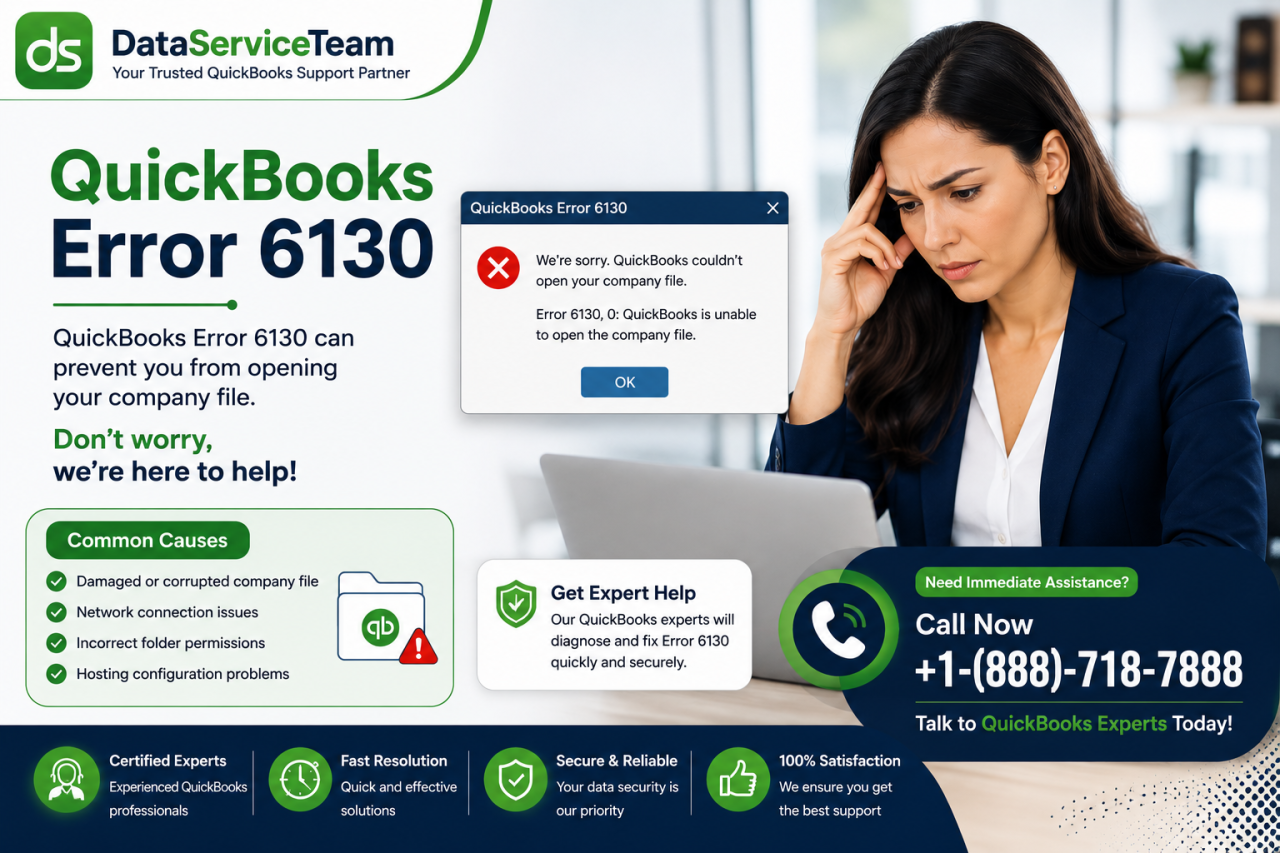
You sit down ready to run payroll, reconcile accounts, and send invoices. You double-click your company file. The loading screen appears. Then—instead of your data—a red error message: "QuickBooks Error 6130: QuickBooks is unable to access the company file." Your heart sinks. Your financial data is right there on your hard drive or server, but QuickBooks refuses to open it. Payroll is due. Invoices need to go out. Your entire workday is on hold.
QuickBooks Error 6130 is a common company file error that belongs to the 6000 series of QuickBooks Desktop errors . It typically occurs when you try to open or access your company file, preventing you from performing essential financial tasks. The error can appear in both single-user and multi-user environments and is often related to file corruption, network connectivity issues, or damaged supporting files . If you are currently locked out of your company file and need immediate help, call 1-888-718-7888.
In this complete guide, we will cover what Error 6130 means, why it happens, and step-by-step solutions to fix it permanently. If your company file still won't open after trying these solutions, call +1-(888)-718-7888 for expert assistance.
What Is QuickBooks Error 6130?
QuickBooks Error 6130 is a database access error that occurs when QuickBooks Desktop cannot open or access your company file . It is part of the 6000 series of errors, which are specifically related to company file access problems .
Common Error Messages
You may see variations of this error:
- "QuickBooks Error 6130: QuickBooks is unable to access the company file"
- *"QuickBooks Error -6130 0"*
- "QuickBooks cannot open the company file. Error 6130"
- "QuickBooks has encountered a problem and needs to close. Error 6130"
When Does Error 6130 Appear?
Scenario | Description |
Opening a company file | You try to open your company file and the error appears immediately |
Switching to multi-user mode | The error appears when enabling multi-user access |
After a system crash | Power outage or improper shutdown corrupted the file |
After moving the company file | The file was relocated to a different folder or drive |
After a network change | Server name, IP address, or network configuration changed |
Symptoms of Error 6130
Recognizing the symptoms can help you identify the issue quickly :
- Company file will not open – QuickBooks displays the error instead of loading your data
- QuickBooks freezes or crashes – The software becomes unresponsive when trying to access the file
- Cannot switch to multi-user mode – The option is grayed out or fails
- Slow performance – QuickBooks runs noticeably slower than usual
- Error pop-ups – Unexpected error messages appear during normal operations
Top Reasons for QuickBooks Error 6130
Understanding the root cause saves hours of trial and error. Here are the real reasons Error 6130 strikes.
1. Corrupted or Damaged Company File (Most Common)
Data damage or corruption in your QuickBooks company file is the primary cause of Error 6130 . This can happen due to power outages, system crashes, improper shutdowns, or network interruptions while QuickBooks is writing data.
2. Damaged .ND or .TLG Files
QuickBooks uses .ND (Network Descriptor) and .TLG (Transaction Log) files to manage multi-user access and track transactions . If these supporting files become corrupted, QuickBooks cannot open your company file. The .ND file stores network-related information, while the .TLG file keeps a record of company file transactions .
3. Incorrect File or Folder Permissions
If your Windows user account or the QBDataServiceUser account does not have Full Control permissions on the folder containing your company file, QuickBooks cannot access the data .
4. Network Connectivity Issues
In multi-user environments, network problems such as unstable connections, incorrect hosting settings, or server name changes can trigger Error 6130.
5. QuickBooks Database Server Manager Not Running
The Database Server Manager must be running on the server computer to allow workstations to access the company file in multi-user mode.
6. Outdated QuickBooks Version
Running an outdated version of QuickBooks can cause compatibility issues with your company file structure, leading to Error 6130.
7. Firewall or Antivirus Interference
Third-party security software may block QuickBooks from accessing the company file, incorrectly flagging it as suspicious.
8. Unstable or Intermittent Internet Connection
For cloud-based or network-hosted company files, an unstable internet connection can cause access failures.
9. Invalid Characters in Company File Name
QuickBooks may fail to process the company file if its name contains characters not allowed by the UNC path, such as %, &, <, >, or spaces between the file name and its extension.
How to Fix QuickBooks Error 6130
Follow these solutions in order. Most users fix Error 6130 within 20 minutes using Solution 1, 2, or 3.
Before You Begin
- Close QuickBooks completely on all computers that access the company file
- Ensure you have a recent backup of your company file before making changes
- Log in as Windows administrator on the computer where you are working
Solution 1: Rename .ND and .TLG Files (Quickest Fix)
This is the simplest and most effective fix for Error 6130. Renaming these corrupted supporting files forces QuickBooks to create fresh copies .
Step-by-Step Instructions:
Step 1: Close QuickBooks Completely
- Exit QuickBooks on all computers
- Press Ctrl + Shift + Esc to open Task Manager
- Ensure no QBW32.exe processes are running
Step 2: Navigate to Your Company File Folder
- Open File Explorer (Windows + E)
- Go to the folder that contains your company file (the .QBW file)
Step 3: Locate the .ND and .TLG Files
- Look for files with the exact same name as your company file but with different extensions:
- .ND – Network Descriptor file (e.g., MyCompany.QBW.ND)
- .TLG – Transaction Log file (e.g., MyCompany.QBW.TLG)
Step 4: Rename the Files
- Right-click each file and select Rename
- Add .OLD at the end of each file name, for example:
- MyCompany.QBW.ND → MyCompany.QBW.ND.OLD
- MyCompany.QBW.TLG → MyCompany.QBW.TLG.OLD
Step 5: Restart QuickBooks
- Open QuickBooks Desktop
- Try to open your company file again
- QuickBooks will automatically create fresh .ND and .TLG files
Why this works: Renaming the corrupted supporting files removes them from the equation. QuickBooks creates fresh, uncorrupted versions automatically when you open the company file. This does not delete any of your financial data .
Solution 2: Run Quick Fix My File and QuickBooks File Doctor
The QuickBooks Tool Hub contains automated tools specifically designed to fix company file issues like Error 6130 .
Step-by-Step Instructions:
Step 1: Download and Install QuickBooks Tool Hub 1.6.0.8
- Close QuickBooks completely
- Go to the official Intuit website and download the QuickBooks Tool Hub
- Install the Tool Hub by double-clicking the downloaded file
- Open the Tool Hub from your desktop
Step 2: Run Quick Fix My File
- In the Tool Hub, select Company File Issues
- Click Quick Fix My File
- Wait for the tool to complete (1-2 minutes)
Step 3: Run QuickBooks File Doctor
- In the Tool Hub, still in Company File Issues, click Run QuickBooks File Doctor
- Wait up to one minute for File Doctor to open
- Select your company file from the dropdown menu, or click Browse to find it
- Choose Check your file (middle option)
- Click Continue and enter your QuickBooks admin password
- Wait for the scan to complete (5-20 minutes depending on file size)
Important Note: If the File Doctor says the scan was "unsuccessful," do not be alarmed. This message sometimes appears even when the issues have been resolved . Always test QuickBooks before assuming the tool failed.
Step 4: Test Your Company File
- Open QuickBooks and try to open your company file
Solution 3: Verify and Rebuild Data Manually
If the automated tools do not fix the issue, use QuickBooks' built-in Verify and Rebuild utilities. These tools scan your company file for data damage and repair it .
Step-by-Step Instructions:
Step 1: Back Up Your Company File
- Before running Rebuild, create a backup
- Go to File → Back Up Company → Create Local Backup
Step 2: Run Verify Data
- Open QuickBooks (if you can open it)
- Go to Window → Close All (to close all open windows)
- Go to File → Utilities → Verify Data
- Wait for verification to complete
Step 3: Review Results
You may see one of three results :
- "QuickBooks detected no problems" → Your file is healthy, no rebuild needed
- "Your data has lost integrity" → Your file is damaged and needs to be rebuilt
- An error message → Search for that specific error
Step 4: Run Rebuild Data (If Issues Found)
- Go to File → Utilities → Rebuild Data
- QuickBooks will prompt you to back up your company file again—click OK
- Choose a backup location (do not overwrite an existing backup)
- Click Save
- Wait for the rebuild to complete (15-45 minutes for large files)
Step 5: Run Verify Data Again
- After rebuild completes, run Verify Data again to confirm repairs were successful
Why this works: The Verify tool identifies data corruption within your company file. The Rebuild tool repairs that corruption, which can resolve database connection errors like 6130.
Solution 4: Update QuickBooks Desktop to the Latest Release
An outdated QuickBooks version can trigger Error 6130. Updating ensures your software has the latest bug fixes and compatibility improvements .
Step-by-Step Instructions:
Step 1: Run QuickBooks as Administrator
- Right-click the QuickBooks icon → Run as administrator
Step 2: Update QuickBooks
- Go to Help → Update QuickBooks Desktop
- Click the Update Now tab
- Check Reset Update (forces a complete download)
- Click Get Updates
Step 3: Install Updates
- After downloads complete, close QuickBooks
- Reopen QuickBooks and install the updates when prompted
- Restart your computer
Step 4: Test Your Company File
- Try opening your company file again
Solution 5: Check File and Folder Permissions
Incorrect permissions can prevent QuickBooks from accessing your company file .
Step-by-Step Instructions:
Step 1: Open Folder Properties
- Open File Explorer and navigate to the folder containing your company file
- Right-click the folder and select Properties
- Click the Security tab
Step 2: Check User Permissions
- Ensure Everyone and Users have appropriate permissions
- If your user account is not listed, click Edit → Add → type your username → Check Names → OK
- Select your user account and ensure Full Control is checked
Step 3: Apply Changes
- Click Apply → OK
- Restart your computer
- Try opening QuickBooks again
Solution 6: Run QuickBooks Install Diagnostic Tool
If Error 6130 persists, your QuickBooks installation itself may be damaged. The Install Diagnostic Tool repairs installation-related issues .
Step-by-Step Instructions:
Step 1: Open QuickBooks Tool Hub
Step 2: Run Install Diagnostic Tool
- Select Program Problems
- Click QuickBooks Install Diagnostic Tool
- Wait 20 minutes for the tool to complete. Do not interrupt the process
The tool automatically repairs:
- Microsoft .NET Framework
- MSXML components
- C++ Redistributables
- QuickBooks installation files
Step 3: Restart and Test
- Restart your computer
- Try opening your company file again
Solution 7: Run Quick Fix My Program
Quick Fix My Program closes background QuickBooks processes that may be interfering with file access.
Step-by-Step Instructions:
Step 1: Open QuickBooks Tool Hub
Step 2: Run Quick Fix my Program
- Select Program Problems
- Click Quick Fix my Program
- Wait 30-60 seconds
Step 3: Restart and Test
- Restart your computer
- Try opening your company file
Solution 8: Check Your Company File Name for Invalid Characters
QuickBooks may fail to open the company file if its name contains invalid characters or spaces between the name and extension .
Step-by-Step Instructions:
Step 1: Locate Your Company File
- Open File Explorer and navigate to your company file
Step 2: Check the File Name
- Remove any symbols like %, &, <, >, @, #, $, ^, *, (, ), +, =, {, }, [, ], |, \, /, :, ;, ", ', ?, ,
- Ensure there are no spaces between the file name and the .QBW extension
- Keep the file name reasonably short
Step 3: Rename if Necessary
- Right-click the file and select Rename
- Remove any invalid characters
- Press Enter to save
Step 4: Try Opening the File Again
- Open QuickBooks and try to open the renamed file
Solution 9: Restore from a Backup
If your company file is severely damaged and cannot be repaired, restoring from a recent backup is your best option .
Step-by-Step Instructions:
Step 1: Open QuickBooks
- Open QuickBooks Desktop (stay on the "No Company Open" screen)
Step 2: Select Restore Option
- Go to File → Open or Restore Company
- Select Restore a backup copy → Next
- Select Local Backup → Next
Step 3: Locate Your Backup
- Browse to the location of your backup file (.QBB extension)
- Select the file and click Open
Step 4: Restore the File
- Choose where to save the restored file (use a different name or location to avoid overwriting)
- Click Save
Step 5: Open the Restored File
- After restoration, open the restored company file
- Run Verify Data to check for any remaining issues
Solution 10: Clean Install QuickBooks Desktop (Nuclear Option)
If nothing else works, a complete removal and fresh installation of QuickBooks will resolve any corrupted program files .
Step-by-Step Instructions:
Step 1: Back Up Your Company File
- Copy your .QBW file to an external drive or cloud storage
Step 2: Uninstall QuickBooks
- Go to Control Panel → Programs and Features
- Find QuickBooks and click Uninstall
Step 3: Run Clean Install Tool
- Download and run the QuickBooks Clean Install Tool (from the Tool Hub)
- The tool removes leftover registry entries and folders
Step 4: Restart and Reinstall
- Restart your computer
- Download a fresh installer from Intuit
- Install QuickBooks and restore your company file
How to Prevent QuickBooks Error 6130
Once you have fixed the error, take these steps to prevent it from happening again.
1. Always Close QuickBooks Properly
Never force-close QuickBooks. Always use File → Exit to close the program properly. Improper shutdowns are a leading cause of file corruption .
2. Maintain Regular Backups
Set up scheduled backups daily or weekly. Keep multiple backup copies in different locations (external drive and cloud storage) .
3. Run Verify Data Weekly
Make it a habit to run File → Utilities → Verify Data every week to catch data integrity issues early.
4. Keep QuickBooks Updated
Check for updates monthly: Help → Update QuickBooks Desktop .
5. Use Reliable Networks
If using QuickBooks in multi-user mode, ensure your network is stable. Use wired Ethernet connections for the server when possible .
6. Maintain Proper Permissions
Ensure all users have appropriate read/write permissions for the company file folder .
7. Configure Security Software Correctly
Add QuickBooks folders and executables to your antivirus exception list to prevent blocking .
8. Keep Your Company File Name Clean
Avoid special characters and spaces in your company file name .
Frequently Asked Questions (FAQs)
Q1: Is QuickBooks Error 6130 the same as other 6000 series errors?
- A: Error 6130 is part of the 6000 series of QuickBooks Desktop errors, which all relate to company file access problems. Other 6000 series errors include -6000, -301; -6000, -82; -6000, -77; and -6147 . While similar, each error has specific causes. Error 6130 specifically indicates a database access failure .
- A: No. The .ND and .TLG files are supporting files that do not contain your financial data. Renaming them will not delete any transactions, customers, or invoices. QuickBooks automatically creates fresh copies when you open your company file .
- A: File Doctor typically takes 5-20 minutes to complete, depending on your company file size. For very large files (over 500 MB), it may take longer .
- A: Yes. You can manually rename .ND and .TLG files (Solution 1), run Verify and Rebuild Data (Solution 3), and check file permissions (Solution 5) without the Tool Hub. However, the Tool Hub automates many repairs and is recommended.
- A: This typically indicates a network issue or problem with the Database Server Manager rather than file corruption. Check that the QuickBooks Database Server Manager is running on the server, and verify hosting settings .
- A: Sometimes. If the error is caused by an outdated version that is incompatible with your company file structure, updating to the latest release can resolve the issue .
- A: Yes. Antivirus or firewall programs can block QuickBooks from accessing the company file. Temporarily disable your antivirus to test, then add QuickBooks as an exception if needed .
- A: If you have tried all 10 solutions and the error persists, your company file may be severely damaged. Restore from a backup (Solution 9) or contact professional support for data recovery assistance .
For direct assistance with QuickBooks Error 6130, call: +1-888-718-7888.
Quick Reference: Error 6130 Troubleshooting Guide
Symptom | Most Likely Cause | Solution |
File won't open at all | Corrupted .ND/.TLG files | Solution 1 (Rename files) |
File opens but has errors | Data corruption | Solution 3 (Verify/Rebuild) |
Error appears after crash | Sudden shutdown damage | Solution 2 (File Doctor) |
Multi-user only error | Network/DB Server Manager | Check hosting settings |
Error after moving file | Permission or path issue | Solution 5 (Check permissions) |
All solutions fail | Severe file corruption | Solution 9 (Restore from backup) |
When to Call for Technical Help
You have tried everything. You renamed the .ND and .TLG files. You ran QuickBooks File Doctor. You ran Verify and Rebuild Data. You updated QuickBooks. You checked permissions. You restored from backup. And QuickBooks still will not open your company file, showing Error 6130.
At this point, the issue is likely one of three things:
- Deep company file corruption that consumer tools cannot repair
- A failing hard drive with bad sectors corrupting your file
- A corrupted Windows user profile preventing QuickBooks from accessing files
For direct assistance with QuickBooks Error 6130, call: +1-(888)-718-7888.
When you call, have this information ready:
- Your QuickBooks version and year
- Your company file size (if known)
- When the error first appeared (after a crash? after an update?)
- A list of solutions you have already tried from this guide
- Your Windows version
Tell the representative: "I have already renamed my .ND and .TLG files, run QuickBooks File Doctor, run Verify and Rebuild Data, and restored from backup. I need help with QuickBooks Error 6130."
Final Thoughts: Get Back Into Your Company File
QuickBooks Error 6130 is frustrating because it locks you out of your financial data. But in most cases, the fix is simple.
Start with Solution 1: rename your .ND and .TLG files. This single fix resolves the majority of Error 6130 cases. If that does not work, run QuickBooks File Doctor from the Tool Hub (Solution 2) and run Verify and Rebuild Data (Solution 3).
Remember these key points:
- Deleting or renaming .ND and .TLG files does not delete your data
- File Doctor is free and automated – let it do the heavy lifting
- Verify and Rebuild can repair data corruption from the inside
- Regular backups are your safety net – always keep them current
Your business runs on QuickBooks. Get back into your company file and keep your business moving.
About the author
Categories










Comments