
Select your language

Social Dude
Accounting And Bookkeeping Services Made Simple Today

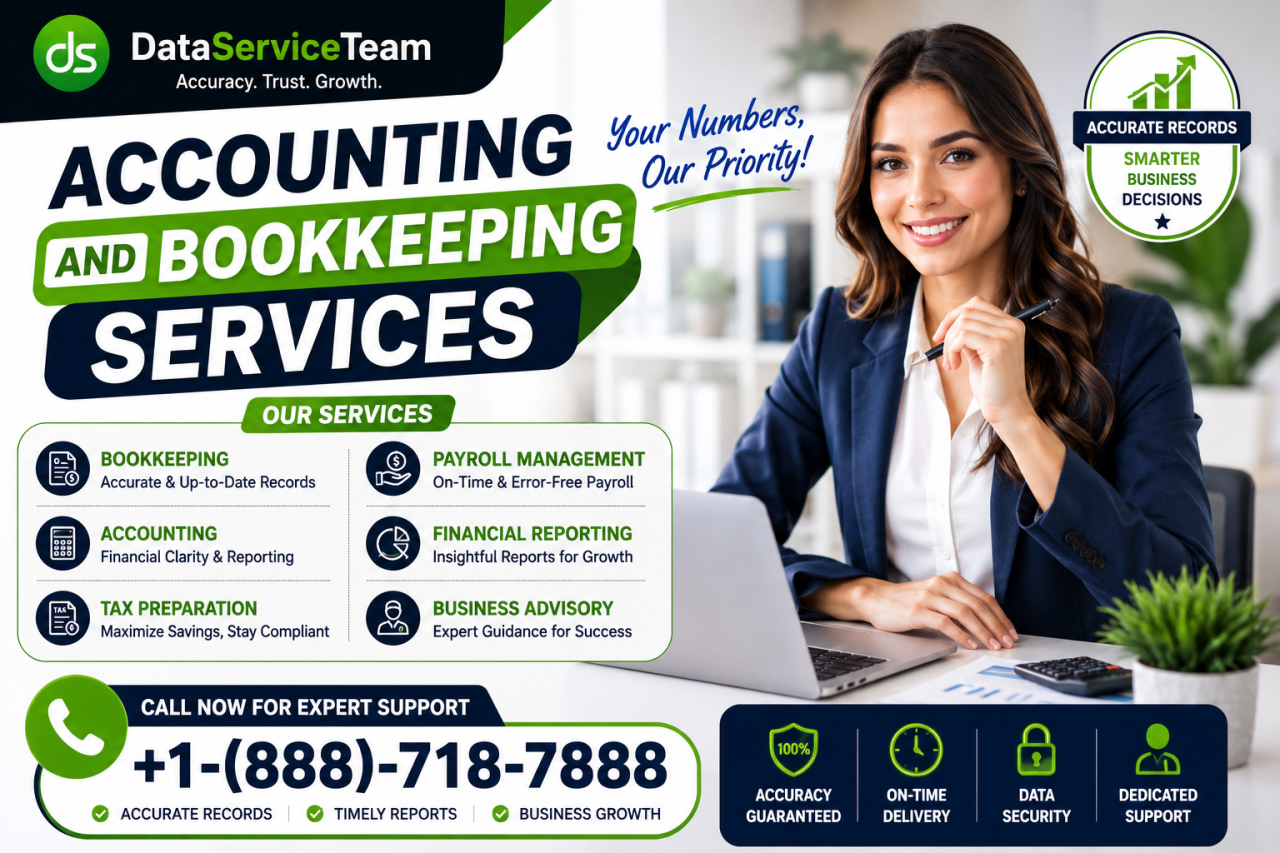
Introduction: Take Control of Your Business Finances
You started your business to serve customers, create products, or solve problems—not to stare at spreadsheets, chase receipts, and reconcile bank statements at midnight. But without accurate books, you cannot make smart decisions, secure loans, or file taxes correctly.
Your business needs professional accounting and bookkeeping services to stay organized, compliant, and profitable. If you need immediate help with your business finances, call +1-(888)-718-7888.
Accounting and bookkeeping services are the backbone of any successful business. Bookkeeping tracks your daily transactions—sales, purchases, payments, receipts—while accounting turns that raw data into financial statements, tax returns, and business insights.
Together, they give you a clear picture of your financial health. In this guide, we will cover what these services include, why you need them, how to choose the right provider, and answers to common questions. If you are ready to outsource your bookkeeping and accounting, call 1-888-718-7888 for professional assistance.
What Are Accounting and Bookkeeping Services?
Accounting and bookkeeping services encompass the day-to-day recording, organizing, and analyzing of your business's financial transactions . While often used interchangeably, bookkeeping and accounting are distinct functions that work together .
Bookkeeping vs. Accounting
Function | Bookkeeping | Accounting |
Primary Role | Recording daily transactions | Interpreting and analyzing financial data |
Tasks | Entering sales, paying bills, reconciling bank accounts | Preparing financial statements, filing taxes, providing insights |
Timing | Ongoing, daily or weekly | Periodic, monthly, quarterly, or annually |
Output | Organized financial data | Financial reports, tax returns, business advice |
Focus | Accuracy and completeness | Strategy and compliance |
Think of bookkeeping as keeping score, and accounting as coaching the team based on that score .
Core Services Included
Most professional accounting and bookkeeping services include :
- Transaction recording – Categorizing income and expenses accurately
- Bank and credit card reconciliation – Matching your books to bank statements
- Accounts payable and receivable management – Tracking bills and invoices
- Payroll processing – Running payroll and filing payroll taxes
- Financial statement preparation – Profit & Loss, Balance Sheet, Cash Flow
- Sales tax filing – Calculating and submitting sales tax returns
- Budgeting and forecasting – Planning for future financial needs
- Tax preparation and planning – Getting your business ready for tax season
- Financial analysis – Understanding trends and opportunities
Why Your Business Needs Professional Accounting and Bookkeeping
Many business owners try to handle their own books to save money. But DIY bookkeeping often costs more in the long run through missed deductions, late fees, and poor financial decisions .
1. Save Time and Focus on Your Business
- The average business owner spends 5-10 hours per week on bookkeeping tasks . That is time you could be spending on sales, product development, and customer service. Professional accounting and bookkeeping services free you to do what you do best.
2. Avoid Costly Mistakes
- Common bookkeeping errors include misclassified transactions, missed bank reconciliations, and incorrect tax calculations . These mistakes lead to overpaying taxes, triggering audits, and making poor business decisions based on inaccurate data.
3. Stay Tax-Ready Year-Round
- Instead of scrambling for receipts at tax time, professional bookkeepers keep your books organized and current . Your accountant will have everything they need to file accurate, timely returns—potentially saving you thousands in deductions you might miss.
4. Make Better Business Decisions
Accurate, up-to-date financial statements show you where your money is coming from and where it is going . With this information, you can:
- Identify your most profitable products or services
- Spot trends before they become problems
- Make informed decisions about hiring, purchasing, and expansion
- Secure loans and investments with professional financials
5. Improve Cash Flow Management
- Poor cash flow is a leading cause of business failure . Professional bookkeepers track your accounts receivable and payable, helping you bill faster and pay vendors on time without running out of cash .
6. Reduce Stress and Gain Peace of Mind
- Knowing that your books are accurate and your taxes are handled removes a huge mental burden. You will sleep better knowing your financial house is in order .
Types of Accounting and Bookkeeping Services
There are several ways to access accounting and bookkeeping services depending on your business size, budget, and needs.
1. Virtual Bookkeeping Services- Virtual bookkeepers work remotely using cloud-based software like QuickBooks Online, Xero, or FreshBooks . They access your books securely from anywhere and provide regular updates.
Best for: Small businesses, e-commerce stores, and remote teams.
2. Outsourced Accounting Firms- Full-service firms offer bookkeeping, controller services, CFO advisory, and tax preparation under one roof . They provide deeper financial analysis and strategic guidance.
Best for: Growing businesses that need more than basic transaction entry.
3. Freelance Bookkeepers- Independent bookkeepers work directly with you, often at lower rates than larger firms . They can be local or virtual.
Best for: Very small businesses with simple transaction volumes.
4. On-Site Bookkeeping- A bookkeeper works from your office, typically part-time, using your computers and software .
Best for: Businesses that prefer in-person interaction or have complex paper-based processes.
5. Fractional CFO Services- A part-time Chief Financial Officer provides high-level strategic guidance, financial modeling, and investor relations .
Best for: Established businesses preparing for growth, sale, or investment.
How to Choose the Right Provider
Selecting the right accounting and bookkeeping services is critical for your business success .
Questions to Ask Potential Providers
Question | Why It Matters |
What software do you use? | Ensure compatibility with your systems |
What industries do you specialize in? | Industry-specific knowledge matters |
How often will you update my books? | Daily, weekly, or monthly updates affect your visibility |
Who will be my primary contact? | Avoid being passed between multiple people |
What are your fees and billing structure? | Hourly, monthly retainer, or per-transaction pricing |
Are you bonded and insured? | Protects you in case of errors |
Do you prepare tax returns? | Some bookkeepers only record; CPAs file taxes |
Can you provide references? | Verify their track record |
Red Flags to Watch For
- Guaranteed refunds – No ethical accountant guarantees a refund
- Promises of "audit-proof" returns – No return is audit-proof
- Refusal to put agreements in writing – Always get a service contract
- Unusually low rates – If it sounds too good to be true, it probably is
How Much Do Accounting and Bookkeeping Services Cost?
Pricing varies based on transaction volume, complexity, location, and service level.
Service Type | Typical Monthly Cost |
Basic bookkeeping (under 50 transactions/month) | $200 - $500 |
Standard bookkeeping (50-200 transactions) | $500 - $1,500 |
Full-service bookkeeping + accounting | $1,500 - $3,500 |
Fractional CFO services | $3,000 - $10,000+ |
Hourly bookkeeping rates | $40 - $100 per hour |
Hourly CPA rates | $150 - $400 per hour |
Many providers offer flat-fee monthly packages, which are more predictable than hourly billing .
What to Expect When You Hire Professional Services
When you engage accounting and bookkeeping services, here is what the typical process looks like :
Month 1: Onboarding- Kickoff meeting to understand your business
- Access setup to your bank accounts, credit cards, and software
- Historical catch-up entering past transactions (if needed)
- Chart of accounts customization for your business needs
- Transaction categorization of all income and expenses
- Bank and credit card reconciliation
- Accounts receivable aging review
- Accounts payable tracking
- Financial statement preparation
- Review meeting to discuss results
- Estimated tax payment calculation (if applicable)
- Sales tax filing where required
- Financial ratio analysis
- Tax preparation working with your CPA (or their CPA)
- Year-end financial statements
- Budgeting for the coming year
Small Business Accounting and Bookkeeping Best Practices
Whether you hire professionals or handle some tasks yourself, follow these best practices :
1. Separate Business and Personal Finances- Open a dedicated business bank account and credit card. Mixing personal and business transactions is the #1 source of bookkeeping errors .
- QuickBooks Online, Xero, or FreshBooks allow your bookkeeper to access your books remotely and provide real-time updates.
- Reconciliation catches errors, identifies fraud, and ensures your books match reality . Do not skip this step.
- Use receipt scanning apps to capture expenses as they happen . Waiting until year-end leads to lost receipts and missed deductions.
- Even if you hire professionals, review your Profit & Loss and Balance Sheet each month . You should understand your numbers.
- Set aside money for taxes with every payment you receive . Do not wait until April to think about what you owe.
- The more your bookkeeper knows about your business, the better they can serve you . Tell them about new products, hires, or changes.
Frequently Asked Questions (FAQs)
Q1: What is the difference between accounting and bookkeeping?
- A: Bookkeeping records daily financial transactions (sales, purchases, payments). Accounting interprets that data to produce financial statements, tax returns, and business advice . Bookkeeping is the foundation; accounting is the analysis .
- A: Most businesses need both. Bookkeeping keeps your records accurate day-to-day. Accounting provides the insights and tax compliance you need to grow . Many firms offer both services bundled together .
- A: Basic bookkeeping for a small business typically costs $200-$500 per month . Full-service bookkeeping and accounting ranges from $1,500-$3,500 per month depending on transaction volume and complexity .
- A: Yes, many small business owners start with DIY bookkeeping using QuickBooks or other software . However, as your business grows, the time commitment and complexity increase. Professional services often save you money in the long run through missed deductions and avoided penalties .
- A: The most common platforms are QuickBooks Online, Xero, and FreshBooks . QuickBooks Online is the industry standard, with over 80% market share among small businesses.
- A: Ideally, daily or weekly. Real-time bookkeeping gives you current financial visibility . At minimum, books should be updated monthly before financial statements are prepared .
- A: Bookkeepers prepare your financial records, but only Certified Public Accountants (CPAs) or Enrolled Agents (EAs) can file tax returns on your behalf . Some bookkeeping firms employ CPAs who can also file taxes.
- A: Professional bookkeeping services carry errors and omissions (E&O) insurance to cover mistakes . Reputable firms will also correct errors at no charge. Always ask about their error resolution policy before hiring.
- A: Yes. A good bookkeeper can take over your books at any point and catch up on past transactions . The transition is easier if you use standard software like QuickBooks Online.
- A: Consider full-time help if you have over 200 transactions per month, multiple locations, complex inventory, or employees . For most small businesses, outsourced part-time or virtual services are more cost-effective .
For professional accounting and bookkeeping services, call: +1(888)-718-7888.
Quick Reference: When to Outsource vs. Do It Yourself
Transaction Volume | DIY (Hour/Week) | Outsourced (Cost/Month) | Recommendation |
0-50 | 1-2 hours | $200-$300 | DIY with software |
50-150 | 3-5 hours | $400-$800 | Consider outsourcing |
150-300 | 6-10 hours | $800-$1,500 | Outsource |
300+ | 10-15+ hours | $1,500-$3,500 | Outsource + controller |
When to Call for Professional Help
You have tried to manage your own books. You use QuickBooks, watch tutorial videos, and reconcile monthly. But you still cannot figure out why your Profit & Loss looks wrong. Your bank reconciliation is off by thousands of dollars. You missed a tax deadline and incurred penalties. Or you simply have no time to keep up.
At this point, you need professional accounting and bookkeeping services .
For expert accounting and bookkeeping services, call: 1-888-718-7888.
When you call, have this information ready:
- Your business type (LLC, S-Corp, Sole Proprietor, etc.)
- Your average monthly transaction volume
- What software you currently use (if any)
- Whether you need tax filing assistance
Tell the representative: "I am interested in professional accounting and bookkeeping services for my business. I need help with [describing your situation]."
Final Thoughts: Get Your Finances on Track
Accounting and bookkeeping services are not an expense—they are an investment in your business success. Accurate books save you money on taxes, help you make better decisions, and free your time to focus on growing your business.
Start by assessing your current situation. Are you spending too many hours on bookkeeping? Are your financial statements always late? Do you dread tax season? If you answered yes to any of these, it is time to bring in professionals .
Choose a provider that fits your budget and needs. Look for industry experience, transparent pricing, and excellent communication . And remember: the best time to get your books in order was last year. The second-best time is today.
Your business runs on financial clarity. Get professional accounting and bookkeeping services and take control of your future.
About the author
Categories










Comments