
Select your language

Social Dude
How Multilingual AI Agents Are Reshaping Global Customer Support

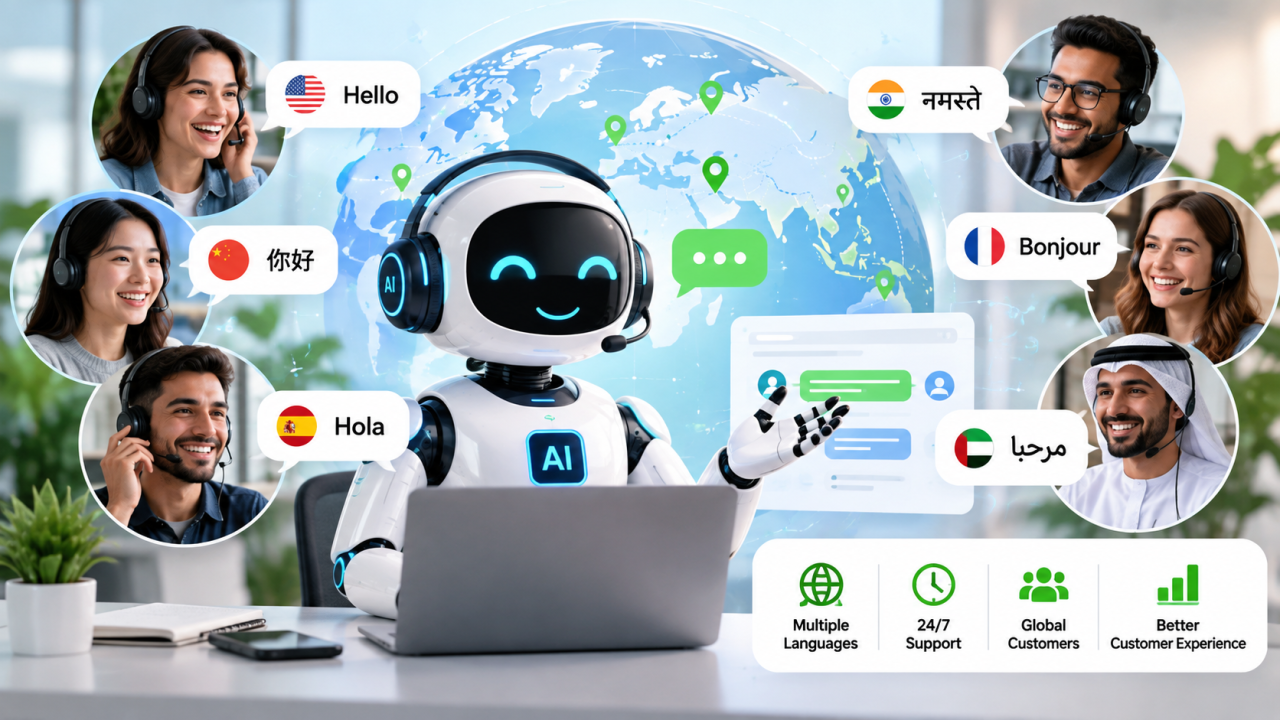
Global customers do not all speak the same language. One writes in Spanish, another switches between English and Hindi, and a third mixes slang, an English product name, and a typo in a single message.
For a long time, companies handled this by translating messages back and forth around a human agent. Multilingual AI agents take a simpler route, understanding the customer directly and resolving the issue in their own language.
The real point is not just translating what the customer said. It is understanding what they mean, finding the right information, and taking the right action in the language they expect.
What Is a Multilingual AI Agent?A multilingual AI agent is an AI system that can interact with users across multiple languages while holding on to the context, business rules, tools, and workflow logic needed to complete a task. The language is the surface. The workflow underneath is the point.
In practice, such an agent can detect the customer's language, understand multilingual or mixed-language input, retrieve relevant business information, use enterprise tools and APIs, respond in the appropriate language, and escalate to a human when required.
Traditional Approach | Multilingual AI Agent |
Translate, process, translate | Understand language within workflow |
Often language-specific flows | Shared agent logic |
Mostly conversational | Conversational and transactional |
Limited context | Customer and workflow context |
Static translations | Dynamic responses |
Separate language maintenance | Shared knowledge and localized behavior |
The important shift is from multilingual responses to multilingual task execution.
Why Global Support Is Harder Than "Just Add Translation"Treating multilingual support as a translation pipeline is the most common misconception, and it breaks down for at least five reasons.
1. Language detection isn't always clean: Customers switch languages mid-conversation, use slang and abbreviations, or mix languages in a single sentence. Code-switching alone is a strong reason multilingual support cannot be treated as a simple translate-then-process step.
2. Meaning isn't always literal: The same phrase can carry different meanings depending on region, context, or industry, and a literal translation quietly loses that nuance.
3. Business terminology needs consistency: A product name, technical feature, policy, or legal term often has a specific approved translation that the agent must use every time.
4. Retrieval has to remain language-aware: The agent must find the right information even when the customer's language differs from the language of the source documentation.
5. Actions still need to work: The hardest part is not producing a translated answer. It is understanding, retrieving, deciding, and executing correctly across languages, which is a much deeper requirement.
A multilingual agent therefore has to separate language from business logic. The customer can speak differently, but the underlying workflow still needs to behave consistently.
The Architecture Behind a Multilingual AI AgentIt helps to picture the flow a request travels through. Customer input arrives, language and intent are detected, context is assembled, knowledge is retrieved, the agent reasons about what to do, tools and APIs are called, validation and guardrails are applied, a localized response is generated, and a human is brought in if the situation calls for it.
Each layer plays a distinct role:
- Language layer. Detects language, locale, mixed-language input, and, where useful, regional preferences.
- Context layer. Combines conversation history, customer profile, account information, the current task, and the customer's language preference.
- Knowledge layer. Retrieves the relevant product documentation, policies, troubleshooting content, and internal knowledge.
- Agent layer. Decides what needs to happen next rather than simply generating text.
- Tool layer. Connects the agent to the CRM, the ticketing system, the order database, billing, and internal APIs.
- Governance layer. Controls what the agent can access and which actions require approval.
The lesson underneath this is that a production multilingual system is about context engineering, permissions, tools, and operational controls, not treating the language model as the entire application.
Where Multilingual AI Agents Are Changing Customer SupportThe value shows up across a handful of recognizable workflows, and this is where a well-built AI agent for customer service starts to change the economics of going global.
1. 24/7 First-Line Support: A single AI support layer can serve customers across many time zones without standing up a separate overnight team for every market.
2. Order and Delivery Support: Customers can ask about orders, delivery changes, returns, or cancellations in their preferred language while the same backend workflow handles the transaction.
3. Technical Troubleshooting: The agent can understand a technical issue described in one language, retrieve documentation stored in another, and return the troubleshooting steps in the customer's language.
4. Billing and Account Questions: The agent can pull account information, explain charges, and start supported account workflows without needing a language-specific human queue.
5. Ticket Triage and Routing: The agent can read the language, intent, urgency, and customer context together before assigning the request to the right workflow or human team.
6. Proactive Customer Support: The company can initiate multilingual outreach for payment failures, delivery delays, renewals, service disruptions, and appointment reminders. This shifts support from a model where the customer contacts the company to one where the company detects an issue, the AI reaches out, and the AI resolves it.
Across all of these, the pattern is triage, retrieval, resolution, and human escalation working as one connected workflow, rather than isolated chatbot responses.
One Knowledge Base, Many Languages: Where RAG FitsA common assumption is that multilingual customer support AI agents need a completely separate knowledge base for every language. In most cases, they do not.
Picture a customer asking a question in Japanese. The system identifies the language and intent, retrieves the relevant product documentation, filters it by the customer, product, and permissions, lets the agent reason over that retrieved context, and finally generates the response in Japanese. One knowledge base, many languages, handled at retrieval and generation time.
The difficult part is not putting documents into a vector database. It is ensuring the right information is retrieved regardless of how the customer asks for it. That brings a set of real considerations into play:
- Multilingual embeddings and cross-language search
- Metadata and permission filtering
- Document freshness
- Language-specific terminology
- Retrieval quality and source attribution
In short, retrieval is the mechanism that grounds support answers in company data, and that holds just as true for multilingual support as for a single language.
Code-Switching Changes the DesignConsider a real message a customer might send: "My order todavia hasn't arrived. Can you check?"
The customer is not neatly selecting a language. They are not English-only and they are not Spanish-only. The system has to understand the combined meaning rather than forcing the message into one bucket.
This has direct design consequences:
- Language detection should not always be a one-time step at the start of the conversation.
- The agent should maintain language and context throughout the interaction.
- Product names may stay untranslated.
- Technical terms may need canonical, approved terminology.
- The customer should never have to repeat their issue after switching languages.
The takeaway is that real-world multilingual support is not a dropdown menu. It is an ongoing context-management problem, which turns an abstract AI concept into a concrete engineering requirement.
Multilingual Doesn't Mean Every Language Should Behave Exactly the SameThere is an important difference between translation and localization, and mature systems account for both.
Translation | Localization |
Converts language | Adapts communication |
Focuses on words | Considers cultural context |
Literal consistency | Contextual consistency |
Same response structure | Region-appropriate interaction |
Language-focused | Language and market-focused |
Localization can affect formality, date and time formats, currency, units, regional terminology, greetings, escalation expectations, and regulatory language. These are not cosmetic details. They shape whether an interaction feels native or merely translated.
The technical implication is that a global AI agent should ideally share business logic while keeping language and regional behavior configurable, rather than maintaining completely separate implementations for every market.
Human Escalation Still MattersMultilingual AI does not remove the need for multilingual support teams. It changes where those people spend their time. The agent understands the request, attempts a resolution, detects when it is uncertain, and hands the human a fully contextualized case.
A good handoff should carry the customer identity, preferred language, conversation history, issue summary, actions already attempted, relevant account information, and the reason for escalation. That is what prevents the maddening experience of explaining the same issue twice after a transfer.
It also helps to distinguish three kinds of escalation. A language escalation happens when the AI lacks confidence in the language or context. A business escalation happens when the issue requires human judgment. A risk escalation happens when the action carries financial, legal, security, or compliance implications. Naming them separately makes the routing far more precise.
The Production Challenges Developers Need to SolveSpeaking twenty languages does not make a system production-ready. Several failure modes have to be engineered around.
Challenge | What Can Go Wrong |
Language detection | Wrong language or missed code-switching |
Retrieval | Correct language, wrong information |
Terminology | Inconsistent product or policy terms |
Hallucination | Incorrect localized answers |
Latency | Multi-stage translation and retrieval slows responses |
Evaluation | One language performs better than another |
Voice | Accent, speech recognition, and pronunciation errors |
Safety | Guardrails behave inconsistently across languages |
Escalation | Customer reaches the wrong support path |
The observation worth holding onto is simple but easy to forget. A system that performs well in English is not automatically a system that performs well globally.
How to Evaluate a Multilingual AI AgentEvaluation should be about far more than translation accuracy. It helps to look across four clusters:
- Language performance. Language detection, intent accuracy, and terminology consistency.
- Customer experience. Resolution rate, CSAT, customer effort, and escalation rate.
- Agent performance. Tool-call success, retrieval accuracy, hallucination rate, and task completion.
- Operational performance. Latency, cost per interaction, availability, and token usage.
The key idea is that evaluation should happen per language, per workflow, and per customer scenario. An agent might perform beautifully in English yet stumble on a Spanish billing issue with a refund request, or a Hindi order-status request that involves code-switching. That is exactly why multilingual evaluation is an engineering discipline rather than a translation benchmark.
Build One Multilingual Agent or Multiple Language-Specific Agents?This is one of the first real architecture decisions, and there is no single right answer.
Approach | Best Fit | Trade-off |
One shared agent | Common workflows across markets | Requires strong language and context handling |
Language-specific agents | Highly localized workflows | More maintenance |
Shared core plus language modules | Most enterprise scenarios | More architecture upfront |
Translation layer plus core agent | Simple support use cases | Context can be lost |
Multilingual model plus localized RAG | Knowledge-heavy support | Requires strong retrieval evaluation |
As a general principle, and without treating it as universal, many global support systems benefit from a shared workflow and policy layer paired with language-aware retrieval and response generation. That reduces duplicated business logic while still allowing genuine market-specific behavior.
A Practical Implementation PathThe most reliable way to build this is one workflow at a time. Here is a six-step path developers can actually follow.
1. Start with one support workflow: Do not begin with "support customers in 30 languages." Begin with "resolve order-status requests in English, Spanish, and German."
2. Identify language requirements: Map the languages, regions, dialects, code-switching patterns, and terminology involved.
3. Connect enterprise context: Integrate the CRM, knowledge base, ticketing, orders, and APIs the workflow depends on.
4. Define agent permissions: Decide exactly what the agent can read, recommend, write, and execute.
5. Build language-specific evaluations: Test normal conversations, slang, typos, mixed languages, ambiguous requests, regional terminology, and escalation scenarios.
6. Expand gradually: Once the workflow performs reliably, grow from three languages to five, then ten, and on toward broader global coverage.
This mirrors the broader 2026 production-agent principle of starting narrow and expanding once the system proves reliable, rather than attempting a broad autonomous system on day one.
What the Global Support Stack Could Look LikeAs a technical wrap-up, the end-to-end flow reads cleanly from top to bottom. A customer message enters, language and intent are detected, context and memory are assembled, multilingual retrieval runs, the agent reasons, tools and APIs are called, business systems are updated, guardrails and validation are applied, a localized response is produced, and a human takes over if needed.
Underneath, the stack can combine LLMs, agent orchestration, RAG and vector search, structured databases, CRM and ERP APIs, tool-calling or MCP interfaces, authentication, evaluation pipelines, and observability. The pieces are largely off the shelf. The engineering is in how they are composed.
The architectural principle to keep in mind is to keep business logic centralized where possible, and make language, terminology, and regional behavior configurable.
Global Support Is Becoming Language-Aware, Not Language-DependentMultilingual support used to be mostly about translation. Now it is about agents that can understand, find information, reason, and act across languages, which is a very different thing.
That shift changes how global support is built. A company no longer needs a separate automation stack for every language, but it does need to design carefully for differences in language, context, terminology, culture, retrieval, and evaluation. This is exactly the kind of system work that Dextra Labs AI agent development services focus on.
The aim is not to make one English support bot speak 20 languages. It is to build a support workflow that works reliably across 20 different customer contexts, because language is only the interface while context, tools, and workflow execution are the real system.

About the author
Categories










Comments